Samuel de Champlain: A Man of Vision and Determination
Samuel de Champlain was born around 1567 in Brouage, a port town in western France. Unlike Jacques Cartier, who came from the merchant class, Champlain was born into a family of minor nobility, which gave him access to education and connections within the French court. His early life included service in the French military campaigns in Brittany and beyond, experience that taught him leadership, discipline, and the management of men in difficult circumstances. Champlain also served in the Spanish military and traveled to the Spanish colonies in the Caribbean, where he gained firsthand knowledge of colonization efforts and the potential for commercial enterprises in the New World.
By the late 16th century, when Champlain began his exploration career, France had a clear strategic interest in establishing a foothold in North America. The failure of the Cartier-Roberval venture and the subsequent long gap in French colonization efforts meant that France had ceded significant territorial claims to other European powers. Spanish colonizers dominated Central and South America and parts of North America, while English and Portuguese explorers were moving into various Atlantic territories. Champlain understood that France needed to establish permanent settlements quickly to secure its claims to North American territory and to develop profitable trading enterprises, particularly the fur trade.
What distinguished Champlain from earlier explorers was his vision of colonization as a long-term commitment. Rather than viewing settlement as a temporary base for exploration or a quick source of wealth, Champlain understood that successful colonization required establishing stable, self-sustaining communities. He recognized the necessity of forming alliances with Indigenous peoples, establishing agricultural production, developing trade networks, and creating institutions of governance and religious practice. This vision, more sophisticated and practical than that of previous French explorers, would ultimately succeed where Cartier's ventures had failed.
Why Quebec? Geographic Advantage and Strategic Vision
By 1608, Champlain had decided that the location known to Indigenous peoples as "Kébec" (where the river narrows) was the ideal site for a permanent French settlement. This location, which would become Quebec City, offered several strategic advantages. The narrowing of the Saint Lawrence River at this point made it easier to control access upriver and downriver, important for trade and for defense. The location was also deep enough in the interior to access the important fur trading networks of the interior while remaining navigable to ocean-going ships. The river provided abundant fish, the surrounding forests provided game, and the location allowed for the development of agriculture in the relatively productive valley lands nearby.
Champlain recognized that Quebec was ideally positioned as a trading center. Indigenous fur traders from the interior would naturally travel downriver to reach this point, where they could exchange furs for European goods. The location also allowed Champlain to build alliances with interior Indigenous nations—particularly the Montagnais (Innu), Algonquin, and Huron peoples—in opposition to the Haudenosaunee Confederacy to the south, whose members were becoming involved with Dutch and English traders. This strategic position would prove crucial for the survival and eventual prosperity of Quebec.
Beyond strategic considerations, Champlain was attracted to Quebec as a location where a European-style city could be developed. The relatively open terrain near the location offered space for construction. The river provided water transportation crucial for colonial commerce. The narrowing of the river made the location defensible. Champlain envisioned Quebec not merely as a trading post but as the capital of a French colonial empire in North America—a vision that, unlike the brief settlements attempted by Cartier and Roberval, would actually be realized.
The Construction of the Habitation (1608)
Champlain arrived at Quebec in July 1608 with a small party of settlers and workmen. The group numbered somewhere between 24 and 32 men, a much smaller contingent than the major expeditions of previous centuries, but one that reflected Champlain's pragmatic approach to colonization. Rather than attempting to establish a large settlement immediately, Champlain built a modest fortified compound that he called the "Habitation." This structure, reconstructed and studied by archaeologists in modern times, consisted of wooden buildings arranged within a palisaded perimeter. The main building contained a storehouse, living quarters, and a common hall where the colonists could gather.
The Habitation was deliberately designed to be defensible. The palisade walls and the strategic location on the riverbank allowed Champlain to control access to the settlement. The design reflected Champlain's military experience and his awareness that the settlement existed in a territory where it was not welcome by some Indigenous groups and where competition with other European colonizers might eventually emerge. The Habitation was not particularly large or elaborate—it was a functional fortress designed to establish French presence and control in a strategic location.
The construction of the Habitation was accomplished with surprising efficiency. Champlain's party, though small, included skilled workers capable of timber framing, carpentry, and basic construction. The work likely proceeded rapidly during the summer months of 1608, as the colonists worked to establish basic shelter and fortifications before the arrival of winter. The completion of the Habitation in 1608 marked the establishment of the first permanent European settlement in what would become Quebec and the foundation of French colonial dominance in North America.
Then Now The Scurvy Winter of 1608-1609: Survival and Loss
The winter of 1608-1609 proved to be nearly as devastating as the scurvy winter that Cartier had experienced decades earlier. The small French community, numbering 28 men at the beginning of winter, was poorly equipped to handle the harsh conditions. Many men lacked adequate clothing for the brutal cold. Food supplies were limited, and the diet, consisting largely of salted meat and fish, lacked the vitamin C necessary to prevent scurvy. The men were confined to the Habitation for months, creating conditions of crowding and poor sanitation that promoted disease.
As winter progressed, scurvy ravaged the settlement. The symptoms—bleeding gums, loose teeth, weakness, and depression—became common among the men. By the time spring arrived, 20 of the 28 men had died, leaving only about 8 survivors. The mortality rate—approximately 71 percent—was catastrophic. Champlain himself fell ill with scurvy but survived, perhaps because of his social position, which allowed him better access to whatever food was available, or perhaps due to luck or individual constitution. The near-destruction of the settlement through disease during its first winter was a humbling reminder of how precarious life was in the colonial frontier.
Yet the settlement survived, and Champlain remained determined to make it work. He understood that the high mortality of the first winter was an aberration caused by poor preparation and inadequate supplies. He resolved to ensure that future winters would be better supplied and that the settlement would grow stronger. More supply ships arrived from France, bringing food and more colonists. The Habitation was reinforced. Plans were made for agricultural development. Quebec, despite its near-fatal first winter, had survived and would endure.
Building the Colony: Development and Growth
After the catastrophic first winter, Quebec developed gradually but steadily. More colonists arrived from France, though the numbers remained modest compared to English colonial ventures. By 1620, Quebec's population was still only around 80-100 people, a far cry from the thousands who inhabited English settlements in Virginia and Massachusetts. However, the composition of the settlement changed as it grew. Initially composed entirely of men—traders, soldiers, and laborers—the arrival of women and families began to transform Quebec into a genuine community rather than a trading post garrisoned by transient employees.
Agricultural development was crucial for the settlement's survival. Champlain and subsequent governors encouraged the cultivation of crops that could grow in the climate, including vegetables, grain, and fruit. Indigenous peoples shared knowledge of plants and cultivation techniques adapted to the North American climate. Livestock—cattle, sheep, pigs—were brought from France and began to thrive in the new environment. By the 1620s and 1630s, Quebec was producing enough food to feed its population and was beginning to export provisions to other French colonies and trading posts.
Champlain understood, from the beginning, that the success of French colonization depended on establishing positive relationships with Indigenous peoples. Rather than attempting to dispossess Indigenous people of their lands through military force, Champlain sought to become an ally of Interior Indigenous nations against their common enemies. This strategy emerged naturally from the geographic and political situation. The Haudenosaunee Confederacy to the south was becoming increasingly armed through trade with Dutch and English colonizers. Indigenous nations of the interior—Montagnais, Algonquin, Huron, and others—saw value in allying with French traders and colonizers against the Haudenosaunee threat.
In 1609, Champlain led an expedition with Indigenous allies, traveling southward on what would become known as Lake Champlain. The purpose was to conduct military operations against the Haudenosaunee. In a significant engagement, Champlain and his Indigenous allies encountered a Haudenosaunee war party. Champlain and other Frenchmen, equipped with firearms more advanced than anything available to the Indigenous combatants, fought alongside their Indigenous allies. The presence of the firearms, which were new and terrifying to many Indigenous warriors, gave the allies a significant advantage. The engagement resulted in a French-Indigenous victory.
This battle was significant for several reasons. It established Champlain as a military ally capable of providing valuable support to Indigenous nations. It oriented Quebec's trade networks and political alliances toward the interior nations rather than toward the Haudenosaunee. It also created a lasting enmity between the French and the Haudenosaunee that would shape North American history for centuries. The Haudenosaunee, allied with English and Dutch colonizers, would become the primary military rivals to French colonial expansion. The consequences of the 1609 battle at Lake Champlain reverberated for more than 150 years, shaping the pattern of colonial conflicts and the ultimate fate of French colonialism in North America.
Experience the Founding of Quebec Today
📍 Visitor Information
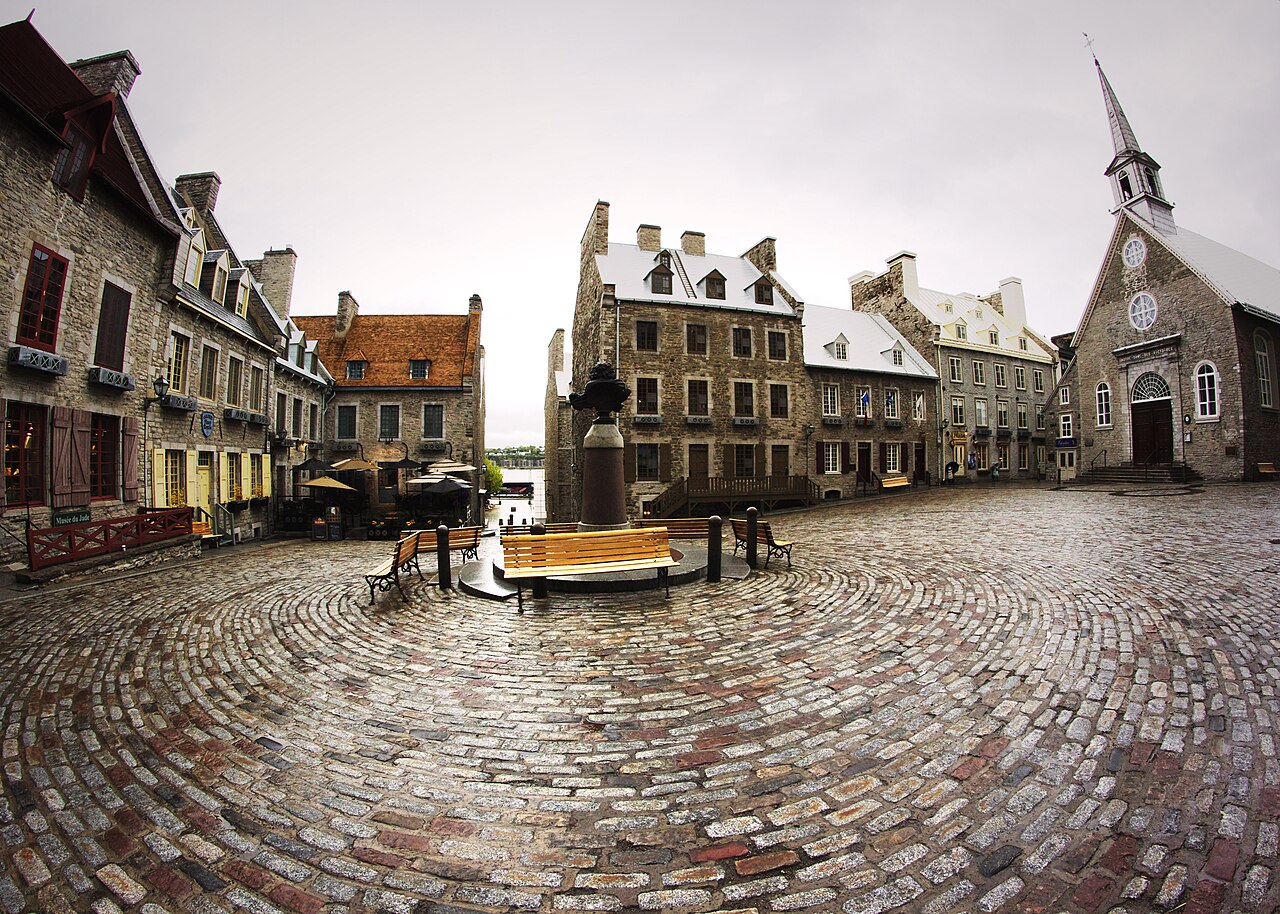
Visiting the Founding Site: Stand where Champlain's Habitation once stood at Place-Royale. The site features museums and interpretive displays explaining the founding and early colonial period. Walk through the historic quarter of Old Quebec, which has preserved much of its 17th-century character. Visit the Cathedral-Basilica of Sainte-Anne-de-Québec to understand the religious mission that was central to French colonization. Take a river cruise to see Quebec from the water, just as Champlain would have first encountered it.
Sources & References
- Champlain, Samuel de. "Voyages of Samuel de Champlain." Champlain Society, 1922-1936.
- Trudel, Marcel. "The Beginnings of New France 1524-1663." McClelland & Stewart, 1973.
- Fischer, David Hackett. "Champlain's Dream: The European Founding of North America." Simon & Schuster, 2008.
- Greer, Allan. "The People of New France." University of Toronto Press, 1997.
- White, Richard. "The Middle Ground: Indians, Empires, and Republics in the Great Lakes Region." Cambridge University Press, 1991.
- Boyd, Robert (Ed.). "The Coming of the Spirit of Pestilence." University of Chicago Press, 1999.
- Parks Canada. "Habitation de Québec National Historic Site." Historical Resources, Government of Canada.